Major & Minor Guitar Scale Exercises
Build fretboard control, picking accuracy and scale fluency with focused play-along major and minor guitar scale exercises. Train major, natural minor and harmonic minor scale patterns at fixed tempos, improve coordination between both hands and develop cleaner, more consistent movement across the fretboard.
Major & Minor Guitar Scale Workouts
Train fretboard control, picking accuracy and scale fluency with focused play-along major and minor guitar scale exercises.
The collection includes 32 repeatable guitar scale workouts covering major, natural minor and harmonic minor patterns. Practise each scale at fixed tempos, coordinate both hands and develop cleaner, more consistent movement across the fretboard as you gradually increase the BPM.
Major Scale Patterns
Train major scale shapes across the fretboard while developing accurate fretting, consistent picking and smoother movement through each pattern.
Natural Minor Patterns
Practise natural minor scale shapes at controlled tempos and build more reliable coordination, fingering and fluency across different positions.
Harmonic Minor Patterns
Train harmonic minor scale patterns with the same controlled approach, developing clean movement, accurate picking and familiarity with its characteristic fingering and interval structure.
Tempo & Fretboard Control
Repeat the scale patterns at different tempos and gradually increase the challenge while keeping both hands synchronized, relaxed and consistent.
How to Use These Major & Minor Scale Workouts
Start at a tempo where you can play the complete scale pattern cleanly and keep both hands synchronized. Follow the workout from beginning to end, focus on consistent movement and increase the challenge only when the pattern remains accurate and controlled.
Choose a Scale Workout
Choose the major, natural minor or harmonic minor scale pattern you want to train and become familiar with the fingering before you begin.
Keep Both Hands Synchronized
Make sure each fretted note and pick stroke arrive together. Keep the movements controlled and avoid adding unnecessary tension as you move across the strings.
Choose a Controlled Tempo
Start at a BPM where every note stays clear and the fingering remains consistent without rushing, hesitating or losing your position.
Repeat and Build Scale Fluency
Repeat the same scale pattern until the fingering, picking and movement across the fretboard become more familiar, automatic and reliable.
Press Play and Follow Along
Stay with the fixed tempo from beginning to end and concentrate on clean notes, accurate fingering, consistent picking and smooth movement across the fretboard.
Increase the Challenge Gradually
When the scale stays clean and controlled, increase the tempo or move to a more demanding workout while maintaining accuracy, synchronization and relaxed movement.
Free Major & Minor Guitar Scale Workout Preview
Watch short excerpts from the Guitar Workout Club major and minor scale workouts.
These play-along workouts focus on clean notes, accurate fingering, consistent picking and synchronization between both hands. Train major, natural minor and harmonic minor scales at different tempos and build better fretboard control, coordination and scale fluency.
Workout Details
- Focus
- Scale Fluency & Coordination
- Preview
- Major & Minor Scale Workouts
- Scales
- Major · Natural Minor · Harmonic Minor
- Tempo
- 60–120 BPM
- Workout Length
- 3–10 min
Major & Minor Guitar Scale Exercise FAQ
What is the best way to practise guitar scales?
Practise scale patterns at a tempo where every note stays clean and both hands remain synchronized. Focus on accurate fingering, consistent picking and smooth movement before gradually increasing the BPM.
Should I practise major and minor scales at different tempos?
Yes. Slower tempos help refine fingering, picking and coordination, while faster tempos challenge control and consistency. Increase the speed only when you can play the complete scale pattern accurately and without tension.
What is the difference between natural minor and harmonic minor?
Harmonic minor raises the seventh note of the natural minor scale by one semitone. This creates its characteristic sound and also changes some of the finger movements and intervals you encounter when practising the scale.
Do guitar scale exercises improve picking accuracy?
Yes. Scale workouts repeatedly coordinate fretted notes with individual pick strokes across several strings, making them useful for developing picking accuracy, string crossing and synchronization between both hands.
How do I become more fluent with scales across the fretboard?
Repeat scale patterns until the fingering and movement become familiar, then practise them in different positions and at different tempos. Consistent repetition helps you move through the fretboard with less hesitation and more control.
Should I memorise guitar scale patterns?
Memorising the patterns is useful, but the goal is not only to remember where the notes are. You also want the fingering, picking and movement to become reliable enough that you can play the pattern cleanly and in time.
Continue Your Guitar Workout
Scale workout finished? Continue training with another focused guitar workout.
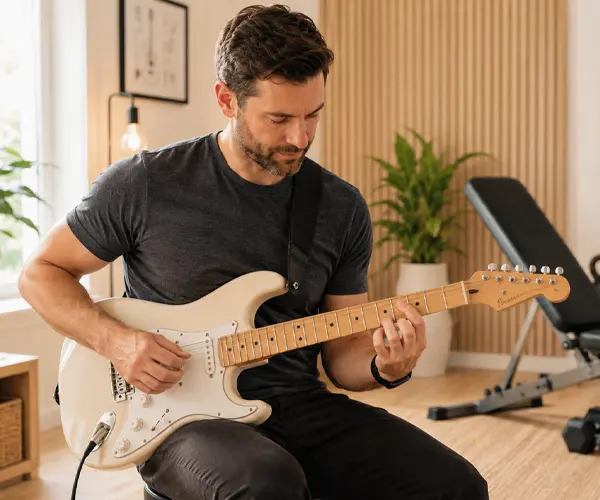
Built for Practice, Not More Theory
Guitar Workout Club was created by Wouter Baustein, guitarist, music producer and guitar coach with more than 25 years of teaching and coaching experience.
One thing becomes clear when working with guitarists at different levels: knowing a scale pattern is not the same as being able to play it cleanly, fluently and consistently across the fretboard at different tempos.
These major, natural minor and harmonic minor scale workouts are built around controlled repetition. By practising scale patterns at fixed tempos, you develop cleaner fingering, more accurate picking, better synchronization between both hands and the fretboard fluency needed for more reliable playing.
Play. Train. Progress.
Designed from real teaching experience. Built for actual practice.
Ready to Train Your Major & Minor Scales?
Choose a scale workout, press play and train cleaner fingering, better picking accuracy, stronger coordination and smoother fretboard movement at different tempos.
Get access to the complete Guitar Workout Club library and keep building your playing with structured workouts you can repeat, challenge and progress over time.
Join Guitar Workout Club ➜Play. Train. Progress.